The Brand That Sends Its Water to the Lab—Willingly
If you have eaten a gluten-free chip, drunken sparkling water made with fruit, or sipped canned tequila, chances are that you are familiar with David Kimmell’s work. With nearly 20 years of experience in supply chain management and logistics, Kimmell is a leader in scaling products, particularly for health-branded companies. He was employee number one at the sparkling beverage company Spindrift, where he worked for 9 years and rose to senior vice president of operations.
When Clara Sieg, a 15-year venture capital veteran, approached Kimmell with the idea of starting a water bottle company, he accepted.
“There hasn’t been much in the way of innovation,” Kimmell said. “There’s an opportunity to build and leverage awareness back to consumers."
A former partner at Revolution Ventures, Sieg started thinking about water purity while pregnant with her daughter.
“I couldn’t make sense of what was actually in our tap water,” she wrote on Substack. “And the more I learned about bottled water, the worse it got. What started as an effort to protect my growing family quickly became an urgency to create something better.”
After a year of searching, they chose a spring in Palomar State Park, just north of San Diego, California. Eventually they visited the site, at one point having to drive backwards downhill in a Toyota 4Runner.
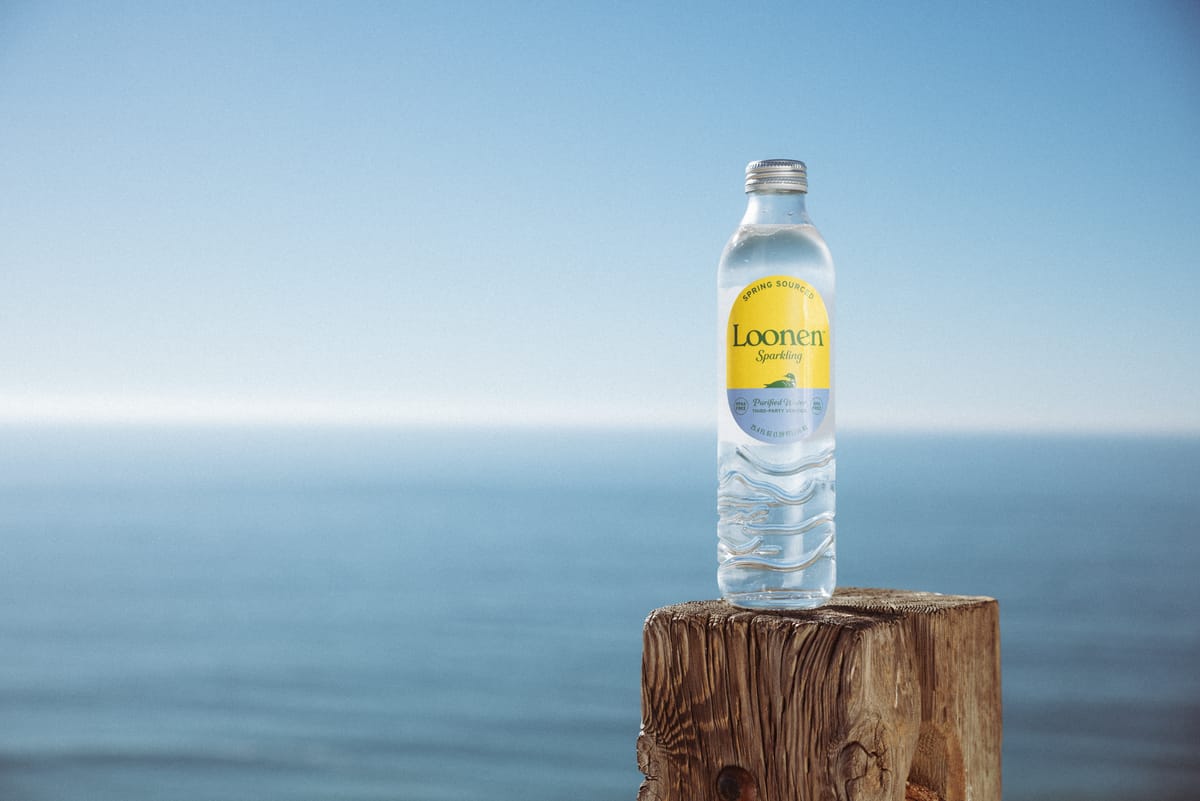
They chose the name Loonen, after the bird species native to the Northern Lakes and known to be sensitive to pollution. Their value proposition is essentially this: find high-quality spring water, filter for contaminants, remineralize for taste, verify for purity via third-party testers, and bring to market in brightly-labelled glass bottles.
In the eyes of the U.S. Food and Drug Administration, water comes in two varieties. You’ve got your filtered tap water and then you’ve got spring water. Tap water can contain nasty things like lead and excess magnesium and calcium. But spring water can contain contaminants, too. Loonen’s product is a combination of what they see as the best aspects of the two categories (although the FDA disallows recognizing this as a third category in itself).
Once the spring water arrives at the bottling center, the water travels via stainless steel tankers and pipes (instead of traditional PVC, to avoid contact with microplastics) to filters. The bottling speed–350 to 450 bottles an hour–is slower than plastic bottling. But their value proposition requires it. They make a point of delivering their water to market in glass because both cans and cardboard can contain plastic lining.
Finding partners willing to start small and then scale was initially a challenge. Kimmell needed to form a unique network based on trust. In addition, quality control is paramount with premium products.
“Everything about your experience has to blow the consumer away,” Kimmell said.
In Fall 2024 they set up headquarters in a Boston suburb. At present the team numbers just seven people. Last month their product became available at San Francisco International Airport and in over 100 area locations, including healthy markets, independent grocers, and cafés.
$3.99 will get you a single bottle, along with a QR code that will direct you to a chemical analysis of its particular contents, completed by four to five labs. Plans are for nationwide availability via Amazon ($29.99 for a six pack) in a couple weeks. Placement in stores in New York City and elsewhere along the East Coast is expected next year. Discussions with national retailers are also under way.
The company targeted San Francisco and Los Angeles as their initial markets because of their especially health-conscious consumer base. The strategy is to demonstrate proof of concept in these markets before expanding nationwide.
“When you're in retail, you realize that distribution basically is the key to everything,” Sara Hendershot, VP of marketing, said. “That's essentially what this market-blitz looks like: trying to penetrate the market, trying to get the brand out there, trying to meet people whom you have lasting relationships with.”
Hendershot is a strong fit for the health marketing space. She twice declined an offer to work at a major investment bank in order to row crew, the second time for Team USA. In total she rowed for six years post-college, through two Olympic cycles.
“My personal motivation for making any kind of health-conscious consumer decision is very much based around wanting to… bring my best self to my work, my kids, my longevity.”
The company aims for a “heritage” brand position rather than a short-lived run. For example, the label draws inspiration from the 112-year-old, Maine-based clothing company L.L.Bean. Simultaneously, the product needs to draw attention. Hendershot notes that the label colors pop on the shelves (particularly the yellow, in my opinion). The water itself comes in both flat or at a high level of carbonation, because that is what consumers are asking for right now, she said.
Being an intrepid journalist, I set out to purchase a bottle at the Guerrero Hill Market in San Francisco over Thanksgiving holiday weekend (I was in the neighborhood seeing family; I didn't jet to SF just to buy a bottle of water). I found a 1.59 pint bottle of the sparkling variety sandwiched between two other brands.
If you're having trouble picturing 1.59 pints, think of how much water that is in terms of beer. More than a pint and a half. That's a solid amount of water. The glass is noticeably thick, too (I assume, to prevent breakage).
I drove home to Orange County that night. The next day I sat by a pool and drank it while trying to think of a final line for this article. It tasted good. I drank it quickly.
I wanted another bottle.