
Boulevard of 77-Page SEC Filings
On March 25th of last year I volunteered as an extra in Nimrods, the Green Day-produced feature film that came out last month. The filming was at the Palladium in Los Angeles. That morning I stood in line for an hour or so with other extras before being shepherded to a bunch of white tables where I listened to a few super-fans soberly belt out the hits.
Afterward I got to watch Green Day repeatedly perform a couple recent singles while the actors and camera crew did their thing. During break they sent us back outside. It was very hot that day and the sandwich they gave me was terrible.
So I left early and drove back to Orange County.
The movie—about a teenage band driving cross-country under the illusion that they're opening for Green Day on New Year's Eve—grossed $910,110 in its opening weekend in over a thousand theaters, $899 per. As my wife put it, it's "a passable watch," which was much better than we had expected.
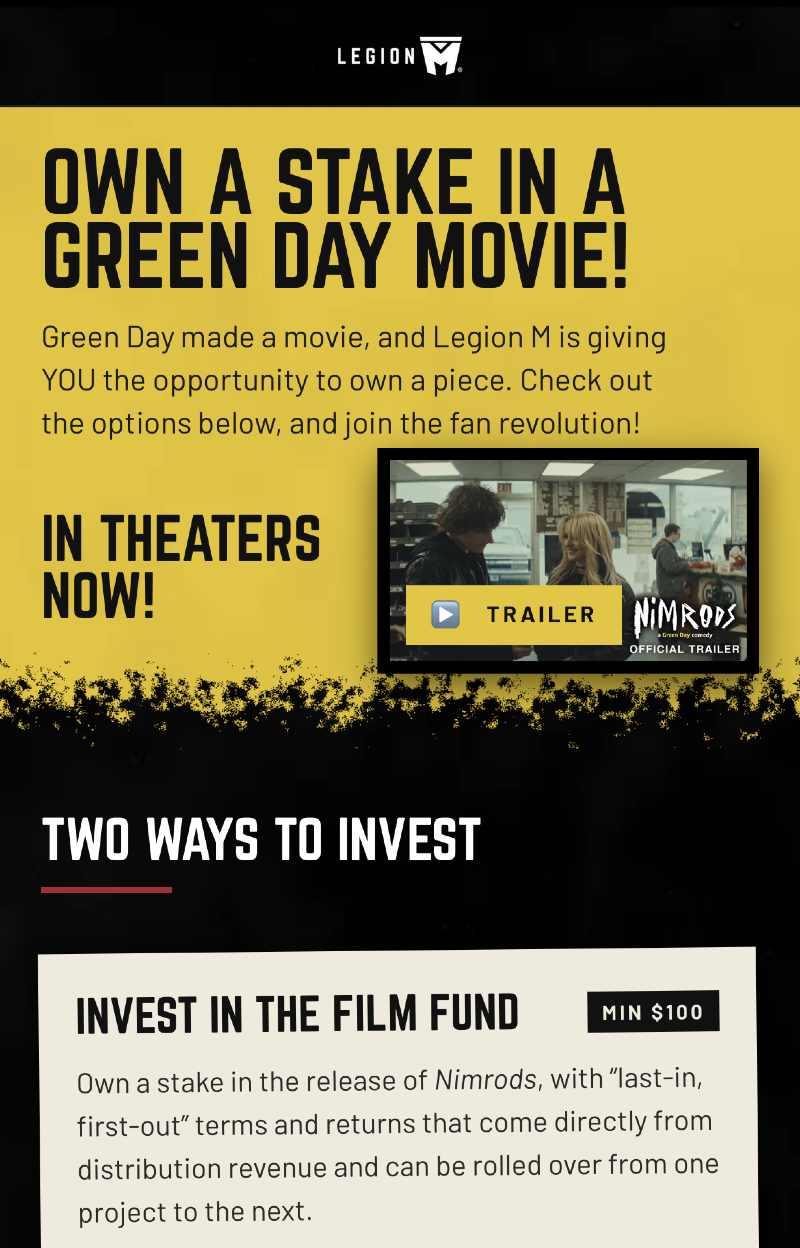
The day before I saw the movie I received an Instagram ad from a company called Legion M, which co-distributed the film, along with Inaugural Entertainment. Legion M sells "community" and fan perks in exchange for money they use to make and/or distribute films. It uses crowd-funding to create LLCs and issue shares to fans.
When I first read the ad, I was, I admit, shocked but not surprised.
Green Day isn't shy about selling. They licensed action figures, Funko Pops, and a videogame. A deal with 7-11. Stickers. A dog bowl. A mask of their bassist's face. A Broadway musical, of course. And they even premiered their own YouTube channel, Green Day TV.
I assumed the Legion M offer means you buy partial ownership of the film itself and receive residuals over time. A movie like this is only going to make its budget back via streaming, I figure.
When I looked at some of the fine print, though, what it actually means is that you invest in a vehicle that holds a part of the distribution budget. Basically Legion M is selling risky, illiquid securities to foster community with other Green Day fans. But why was I being asked to help cover distribution for this film?
From what I gather, if you gamble $108.50, at minimum, on their distribution budget, you can make $6.50 in profit: a $100 ticket, plus an 8.5% "financing charge," against returns capped at 115%, which Legion M hopes to pay out within twelve months. Nimrods just did $899 a theater. As of Sept. 16, the box office is less than $1.3M.
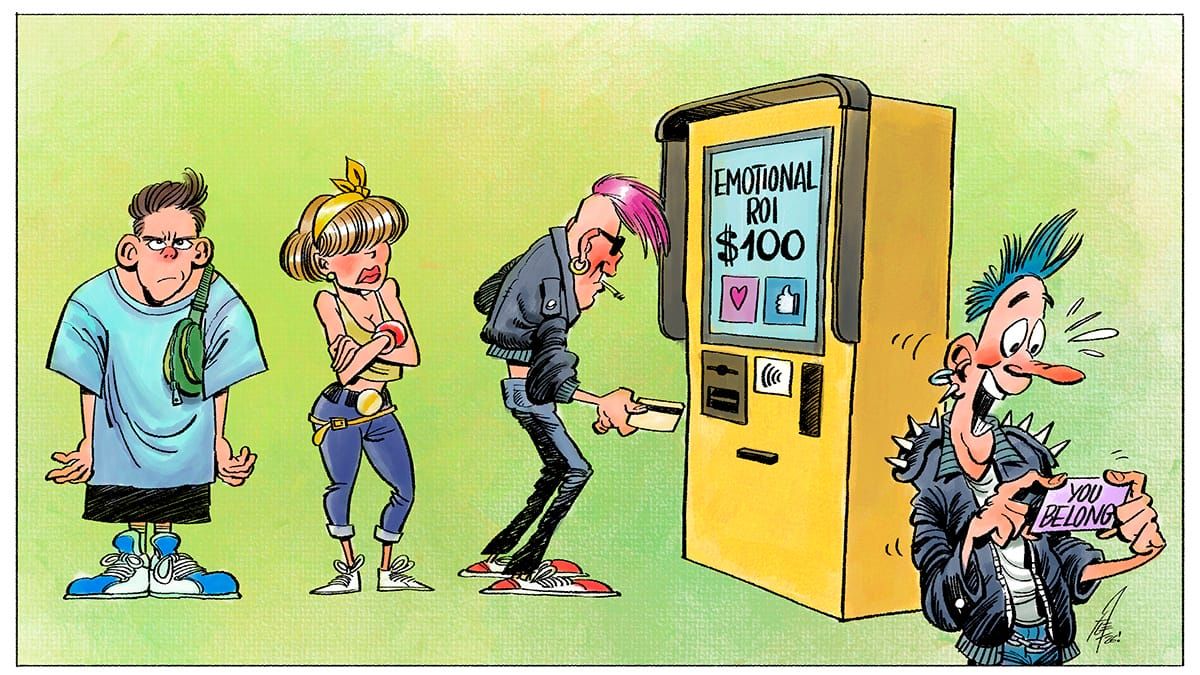
Legion M stated that they deliver "emotional ROI" to the fans who participate in their crowd-funding rounds. Page 4 of Legion M's 77-page October 5, 2021 Offering Memorandum reads:
While financial success is the primary goal for Legion M, there is more to life than money. In addition to financial return, we strive to give our investors an emotional return for owning shares of our Company.

Crowdfunding for independent movies is normal, but this isn't an indie. The film is co-owned by the studio arm of Live Nation Entertainment, the world's largest live-entertainment company.
Legion M, Inaugural Entertainment, and Live Nation Studios did not respond to requests for comment at the time of writing.
To give you a sense of Green Day's draw, the U.S. leg of their Hella Mega Tour, which they headlined with Weezer and Fall Out Boy in 2021, grossed $67.3M. And Live Nation Entertainment booked $25.2B in revenue last year.
One of Legion M's investment theses is that crowdfunding is part of Hollywood's future. I agree. A lot is changing in the development and creation of movies, and the economics are increasingly difficult. So to get niche content made, sometimes you need to turn to fans to make rent. Make it up in streaming. Blah blah blah. I get it. I am with you.

But not this movie, not this band. Green Day prints money. They can afford their own film distribution. They don't need a handout.
TL;DR: Despite volunteering as an extra, I do not appear in the Green Day movie.
Update, September 25. Jeff Annison, co-founder and President of Legion M responded via email after the article was originally published. The full response appears below.
Thanks so much for reaching out. I'm sorry I didn't get a chance to respond to you sooner, but I'm just now seeing this email.
I read your article, and I appreciate you reaching out for comment before publishing it. Happy to answer questions if you still have them. A couple notes worth mentioning.
Green Day didn't need our money, nor did they ask for it. This wasn't a "support our release" sort of thing. Legion M saw the movie at Toronto, and approached Live Nation to acquire the rights. We ultimately ended up partnering with Inaugural, who was also interested.
The whole goal of the film fund is to give investors relatively "safe" (for a movie investment) investments. we're not swinging for the fences, we're trying to grind out singles and doubles that add up to wins.
The 8.5% fee charged is basically us passing through the platform fee from Dealmaker, which is the SEC registered platform we use to raise money (which is required under Reg CF). It's a huge fee, but there's no way around it. Legion M doesn't charge any fees for the film fund, but this one has to be covered one way or another. We could have buried it in the fine print and covered it as part of the funds hard costs, but we thought it was better to be transparent and put it right up front.
The good news is, the fee only gets charged once, when you put money in. After that, the only costs against the profits of the fund are things like legal and accounting which we hope will be fairly negligible.
The intent of the Film Fund isn't to back one film and make money from it. Even without the fee, a 15% capped ROI isn't something to get excited about. If it takes 2 years, that's only 7.5% apr (before fund costs are factored in, which might drop it a bit more). If the movie is a hit (like Coyote vs. Acme, which is also in the Film Fund), an investor might get their money back in 6 months, but that's likely the exception rather than the rule. It's too early to say how Nimrods will do -- it depends heavily on VOD sales over the first 6 months.
The power of the film fund is that funds roll over from one project to the next. For example, the film fund's investment in Fackham Hall earlier this year isn't whole yet, but it has already received 49% of capital recouped. All that money is already working for people in Nimrods, even as they wait for the remaining 51% and the 15% profit to roll in.
We have other investments that are more focused on the "emotional ROI" piece (e.g. getting your name in the credits). You can invest in Legion M, and own equity in the world's first fan-owned movie studio. Or you can back production financing of movies like Shatner, Zoe, and Fade To Black. But those are all very high risk investments. There's potential for high rewards, but the odds are stacked against you. We're very up front about that fact.
The film fund represents the other end of the spectrum. It doesn't have home run potential, but it also doesn't have the risk. We're excited to be able to offer it so that investors have multiple ways they can invest in movies.
I hope that helps. Best of luck with your site. And I'm sorry to hear you didn't make it into the movie.