
Seeking Mercurial Guy Who's Into Fonts

There's another book out about Steven Paul Jobs (1955-2011), co-founder of Apple and Pixar. But why?
I've seen both biopics: the Ashton Kutcher propaganda film (so many times) and the maudlin Sorkin one (twice). I read the authorized Isaacson biography and Becoming Steve Jobs by Brent Schlender and Rick Tetzeli.
It is difficult to once again tune into the saga of a guy whom I would rather not have worked for, nor been fathered by, as much as I liked playing Oregon Trail on my grade school's Apple computers, or listening to that bad, free U2 album on my iTunes account in 2014.
Yet after I wandered into my local Barnes and Noble with time to kill, I passed on a copy of Cory Doctorow's Enshittification for Steve Jobs in Exile: The Untold Story of NeXT and the Remaking of an American Visionary by Geoffrey Cain.

My Own Worst Enemy
The book traces Jobs's founding of NeXT after his exile from Apple. Jobs incorporated NeXT in 1985, seeking to cater to educational, business, and other sophisticated clientele.
NeXT had a stressful, litigious beginning. Apple sued Jobs for stealing trade secrets almost immediately, a suit that was only settled in January 1986 because NeXT had no product yet to steal.
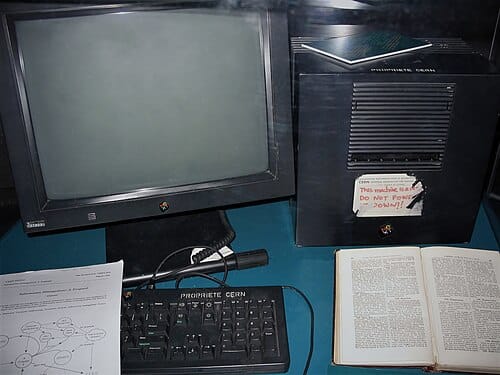
Jobs promised to deliver a $3,000 product to an initial group of university clients. The final price came in at more than twice that and the operating system was in something called alpha phase, which basically means that it wasn't ready. His showmanship was still so great that when he announced the price at one presentation, he received ringing applause.
Much of the first half of the book revisits Jobs's chaotic antics as a manager. It's a hard read and I'd rather not revisit this, so let's not.
Two cameos worth mentioning: 1) John Perry Barlow, the Grateful Dead lyricist, wrote for NeXTWORLD magazine. 2) The first-person shooter game Doom was developed on a NeXT computer and when one of the creators sought to mention NeXT in the game credits, Jobs turned him down (he felt games were not serious enough to be worthy of associating with).

A Well-Respected Man
Jobs was forced to take on the CIA and NSA as clients due to cashflow pressures (he was opposed to it for branding reasons and thought that government work wasn't "cool"). When I imagine Steve Jobs selling computers, I channel a lanky, smelly man in jeans and turtleneck with no shoes on. I hear rambling about Bob Dylan. I don't picture him in an Armani suit shilling apps that simulate battlefields.
But this version exists too, apparently.
By the time Jobs listened to his customers and minded sustainable market segments, it was almost too late. In early 1993, he was forced to pivot, selling the hardware division to Canon and shutting down his state-of-the-art factory to focus primarily on software licensing. By then, IBM, Motorola, and Apple had formed an unholy union to standardize computer processors and NeXT was mere days away from insolvency.
Things got even worse. There was an attempted coup against Jobs reminiscent of what happened at Apple with John Sculley. Eventually all the remaining co-founders left. Steve's adoptive father died. About the only durable net-positive that happened for Jobs in the first 200-odd pages is his marriage to Laurene Powell, a Stanford MBA, and the birth of their son, Reed.
Tumbling Dice
The real payoff of Cain's book is the granular details of how a remade Steve Jobs navigated his return to Apple in September 1997.
Start with the internet going mainstream. Netscape IPO'd in August 1995 and was trading at a $2.9B market cap. Within days of the IPO, Jobs began repositioning NeXT around WebObjects, a groundbreaking software suited to online retailing that would one day form the backbone of the iTunes store.
Jobs's friend, Oracle founder Larry Ellison, floated the idea of a hostile takeover of Apple to install Jobs as CEO. While Jobs demurred on the takeover, the seed of his return was planted.
Meanwhile in Cupertino, Apple was hemorrhaging cash under CEO Gil Amelio. And getting their operating system issue solved was a looming nightmare.
This desperation led to a contest to be Apple's next operating system between NeXT and another company called Be Inc., led by Jean-Louis Gassée, arguably Jobs's biggest rival at Apple when he was pushed out. This part reads like a script, but for whatever reason neither of the two film scripts touched on this. While BeOS was initially the frontrunner, the NeXT team delivered a superior presentation that won over Apple's engineers.
So NeXT, and its $50M debt, was absorbed by Apple. And CEO Gil Amelio's tenure was not long for this world.
As Cain has it:
NeXT executives thought Gil failed to grasp what Steve's twelve years in the wilderness had given him. Steve came away not only with better skills for building technology but better strategies for getting exactly what he wanted.
Jobs joined Apple as a consultant to Amelio. He succeeded in getting his NeXT people top positions since it was their OS that was being integrated. Ellison made a play for Apple with Steve's name attached.
Then came the tactical checkmate: Jobs sold 1.5M shares of Apple stock at about $14 each, which, charitably, coincided with the stock imploding 📉📉📉. He got himself a board seat, threatened to resign from said board, and next thing you know, Steve's back as interim CEO.
His final display of growth was striking a deal with Bill Gates: Microsoft put $150M into non-voting Apple stock and committed to five more years of Office for Mac. In exchange, Internet Explorer became the Mac's default browser.
TL;DR: Jobs lore is the product. The computers were just customer acquisition. 😵💫